Geometry in our daily lives.


Geometry, for me, is one of the most useful of all branches of mathematics. Carpenters, engineers, architects, and for me, as an Interior Designer, all need to know geometry so that the things that they build will look pleasing and will function properly.

Navigators on ships and airplanes also use geometry to guide them across the distances. Artists (like me) use geometry to make their two-dimensional painting looks real. Surveyors marking the boundaries of property use geometry. Everywhere that shapes and lines are important, geometry is used.

We use geometry in our daily lives, but do we all know where it originated?
Showing posts with label euclid. Show all posts

Thursday, March 22, 2012

Euclid's Axiom and Postulates

Euclid's 5 postulates
The "Elements”, Euclid's textbook, was a comprehensive compilation and explanation of all the known mathematics of his time, including the work of Pythagoras, Hippocrates, Theudius, Theaetetus and Eudoxus. In all, it contains 465 theorems and proofs, described in a clear, logical and elegant style, and using only a compass and a straight edge. Euclid reworked the mathematical concepts of his predecessors into a consistent whole, later to become known as Euclidean geometry, which is still as valid today as it was 2,300 years ago, even in higher mathematics dealing with higher dimensional spaces. It was only with the work of Bolyai, Lobachevskiand Riemann in the first half of the 19th Century that any kind of non-Euclidean geometry was even considered.
The "Elements” remained the definitive textbook on geometry and mathematics for well over two millennia, surviving the eclipse in classical learning in Europe during the Dark Ages through Arabic translations. It set, for all time, the model for mathematical argument, following logical deductions from inital assumptions in order to establish proven theorems.


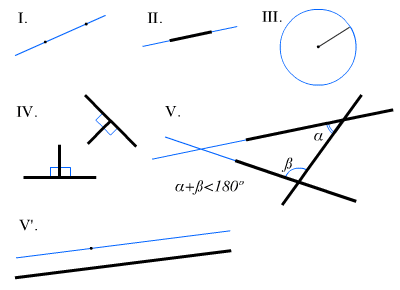
Euclid's POSTULATES:
1. A straight line segment can be drawn joining any two points.
2. Any straight line segment can be extended indefinitely in a straight line.
3. Given any straight line segment, a circle can be drawn having the segment as radius and one endpoint as center.
4. All right angles are congruent.
5. If two lines are drawn which intersect a third in such a way that the sum of the inner angles on one side is less than two right angles, then the two lines inevitably must intersect each other on that side if extended far enough. This postulate is equivalent to what is known as the parallel postulate.

Euclid's fifth postulate cannot be proven as a theorem, although this was attempted by many people. Euclid himself used only the first four postulates ("absolute geometry") for the first 28 propositions of the Elements, but was forced to invoke the parallel postulate on the 29th. In 1823, Janos Bolyai and Nicolai Lobachevsky independently realized that entirely self-consistent "non-Euclidean geometries" could be created in which the parallel postulate did not hold. (Gauss had also discovered but suppressed the existence of non-Euclidean geometries.)

Euclid's AXIOMS:
1. Things which are equal to the same thing are equal to each other.
2. If equals are added to equal, the wholes (sums) are equal.
3. If equals are subracted from equals, the remainders (differences) are equal.
4. Things that coincide with one another are equal to one another.
5. The whole is greater than the part.


    The Father of Geometry


    In my researches, I found out that the one who discovered Geometry is Euclid.

    Euclid was a Greek mathematician who lived in ancient Greek colony of Alexandria, in Egypt about 300 B. C.. He is sometimes called as the "Father of Geometry." His geometry textbook which is called, Elements, has appeared in more than 1,000 editions since printing was invented.

    I also learned that Euclid's greatest contribution lay in the way in which he approached geometrical problems. His starting point are five postulates- statements that he decided were true.

    Other mathematicians have long accepted four of Euclid's postulates, but the fifth was never proved. The fifth statement says that the two parallel lines will always stay the same distance apart, no matter how long you make them. A man named Riemann used a different postulate that says that all straight lines intersect. This "non-Euclidean geometry" was used by Albert Einstein in his Theory of Relativity.

    King Ptolomy of Egypt once asked Euclid if he could not make his mathematics Easier, and Euclid humbly replied, "Sire, there is no royal road to geometry."


    Since Euclid's time, many new properties of figures have been discovered, and today the study of geometry is offered in most schools.

    Geometry is one of the most important branches of mathematics.